Showing posts with label Chapter 2. Show all posts

Thursday, 26 September 2019

Sharon Church

Jewellery Style

Sharon Church creates contemporary pieces that mimic the natural world and that use actual organic materials as part of the design (Church, 2012). Church incorporates carved wood, bone and horn into many of her pieces. See figure 18 below


Figure 18 - – Church, S., (2016) J. Organic Brooch, 
Carved and Dyed Pear Wood. Sterling Silver,
 , Nickel Silver, Diamonds. [ONLINE] 18

She also uses techniques such as casting, forging, enamelling and setting to create jewellery that is organic in form as well as in material (Church, 2016). Many of her pieces resemble leaves, pods, plants flowers, and animals such as insects and amphibians and some of her pieces are more abstract resembling spheres or elongated curved forms (Church, 2012). Church creates her jewellery pieces to form metaphors of her personal life. 


Design process

Design process

similarly to Beth Legg and Victoria Walker, Church also relies on the natural environment around her for design inspiration (Church, 2012). Church goes on walks and retrieves interesting objects and materials that are useful to the construction of her pieces. Church also creates drawings of the items that she collects to aid her in her design process (Church, 2016).
The below jewel that Church created seems to resemble a type of seed pod.


Figure 19 – Church, S., (2000). 
Medal For a Bleeding Heart,
 Commemorative Brooch [ONLINE] 19


Victoria Walker

Design Process

Victoria Walker creates kinetic pendants that resemble seedpods and flowers. Each of these pendants have a special symbolic meaning connected to the type of flower or pod that the pendant resembles (Walker, 2018). Walker goes out into her environment for design inspiration. On walks, walker collects interesting flowers, plants and seedpods which she stores in her studio (Victoria Walker Jewellery, 2017). After collecting design matter, she disassembles each structure so that she can observe the construction of the object (Victoria Walker Jewellery, 2017). Walker also uses the matter that she has collected to create drawings to help her in the construction of prototype pieces (Victoria Walker Jewellery, 2017). After she has created working prototypes in copper, she then creates final pieces from precious metals (Victoria Walker Jewellery, 2017). These techniques help her to accurately observe and understand the natural object that she wishes to recreate in metal (Victoria Walker Jewellery, 2017).

Pictured below are images of Walker's making process, First Walker will sketch the plant used for inspiration, she will then create a copper prototype of the jewel: 

Figure 11 – Walker, V. Constable, N., Victoria Walker
Jewellery, Frame: 01:13. [ONLINE]11

Figure 10 – Walker, V. Constable, N., Victoria
Walker Jewellery, Frame: 01:00. [ONLINE]10

Metaphor and Movement

Metaphor and movement

Walker says that her jewellery is not only sentimental to her as a maker, but they also, become sentimental to the wearer as her customers often purchase her jewellery as they serve as reminders of emotional events in people’s lives. Customers may purchase a flower pendant of the same species of flowers that they had at their weddings to act as reminders of their special day (Victoria Walker Jewellery, 2017). Walkers pieces have a precious quality to them, not just because they are made with precious metals but because they create a sense of sentimentality when the beauty, that is kept hidden inside the closed flower locket, is suddenly and surprisingly revealed when opened to an unsuspecting eye (Walker, n.d.). Walker creates "the idea that sometimes the most precious and treasured elements are hidden beneath the surface " creating a beautiful metaphor that describes the human soul (Walker, n.d.).


Walker, V. Woman and Child Viewing Sunflower
 Locket. Kinetic Flower Pendant, Sterling Silver,
 18ct Gold and diamond. [ONLINE]

Motifs and Techniques

Motifs and Techniques

walker creates moveable flower pendants, earrings and rings out of sterling silver and gold and even though she uses precious metals in her pieces, her style of work is organic as she mimics the forms and textures of flowers in a realistic way, that specific type of flowers can be recognized(Walker, n.d.) . Many of her jewellery pieces are made to look and move, like small scaled-down versions of the plants that she uses for her inspiration. 

Her most popular pieces are kinetic pieces that resemble various species of flowers that open and close when manipulated by hand or when the body moves (Walker, n.d.). Pictured below are Walker's kinetic lockets:


Figure 12 – Walker, V. Sunflower Locket. 
Kinetic Flower Pendant, Sterling Silver, 
18ct Gold and diamond. [ONLINE]12


Figure 13 - – Walker, V. Sunflower Locket. 
Kinetic Flower Pendant, Sterling Silver, 
18ct Gold and diamond. [ONLINE]13


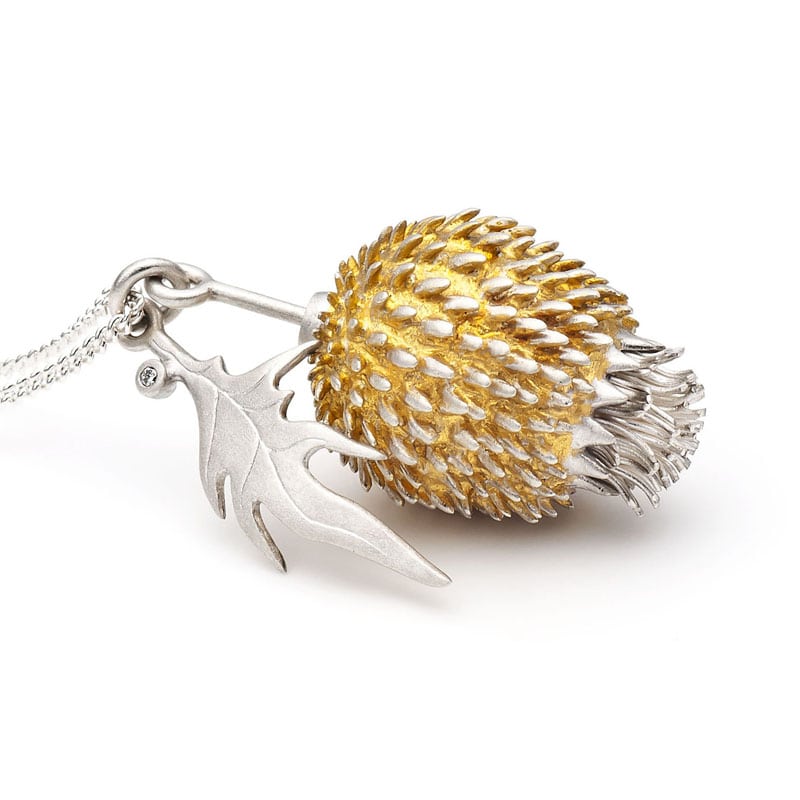
Walker's kinetic lockets are hand made using the techniques of piercing, doming, drilling and soldering (Victoria Walker Jewellery, 2017).Walker also uses various metals to recreate the different colours and hues found in nature, including silver,  and gold and they are buffed and sanded to have a rough, non-shiny finish to resemble the plant of inspiration (Victoria Walker Jewellery, 2017).


Figure 14 - – Walker, V. Thistle Locket.
 Kinetic Pod Pendant, Sterling Silver,
 18ct Gold and diamond. [ONLINE]14


.As a contrast, some of her pieces are decorated with small shiny stones or pearls that allow her pieces to appear more delicate and precious (Walker, n.d.). Although Walker’s jewellery is contemporary in style, because of the small scale of her designs, they become easily wearable as intimate keepsake pieces (Walker, n.d.).

Below are process pictures to show how her kinetic flowers are assembled:


Figure 15 – Walker, V.,(2018) Victoria Walker Jewellery, 
Frame: 00:10. [ONLINE]15


Figure 16– Walker, V.,(2018) Victoria Walker 
Jewellery, Frame: 00:12. [ONLINE]16


Helen Shirk

Design Style

Shirk is known to make jewellery that is worn on the body as well as sculptural vessels that adorn a room, such as bowls, vases and other hollow-ware (Keaffaber, 1990). Shirk has not always been inspired by the natural world and only in her recent years has she started introducing a more organic style in her works. “Her work gradually shifted from the cool sleek silver objects she made in the ’70s to a more personal approach and larger scale through the ’90s” (Psfa.sdsu.edu, 2019) In earlier years, Shirk’s focus was on making interesting formed vessels in bright colours using various techniques such as repousse, chasing, etching, hammering and colouring using different patina recipes. In more recent years, Shirk shifted in making jewellery using mild steel sheets which she intricately pierced out and coloured to resemble silhouettes of plants and layering them to create false depth (Psfa.sdsu.edu, 2019). Shirk's works are made to express personal metaphors that she experiences in life. 

Figure 8 – Shirk, H., (2014). Neckpiece
Number 7
. Neckpiece, Oxidised Mild
 Steel and China Paint. [ONLINE]8

Kelly Jean Conroy

Jewellery Style


It can be said that Conroy creates organic contemporary jewellery with many of her pieces that are organic representational, reflecting images and motifs found in nature. She also incorporates actual natural organic materials into her works. Many of Conroy’s wearable jewellery pieces consist of sketches of birds and flowers that are etched onto metal discs, stones, enamelled copper discs and mother of pearl shell which she sets into frames of blackened silver to form necklaces, earrings and rings (Lark & Key, n.d.) . She also creates contemporary pieces that are made for exhibitions and galleries. These artistic jewellery pieces consist of fragments of bone, eggshell, dried foliage, dead bodies of birds and small mammals and pierced elements in metal (Boston Voyager, 2018). She combines these elements with blackened silver and brightly coloured gemstone beads, discs of etched enamel, metal, shell and flat shards of gemstone slices (Boston Voyager, 2018). Conroy sources all of her design elements from her childhood memories and finds it important that the motifs of nature used in her designs have a personal significance to her (Conroy, n.d.).

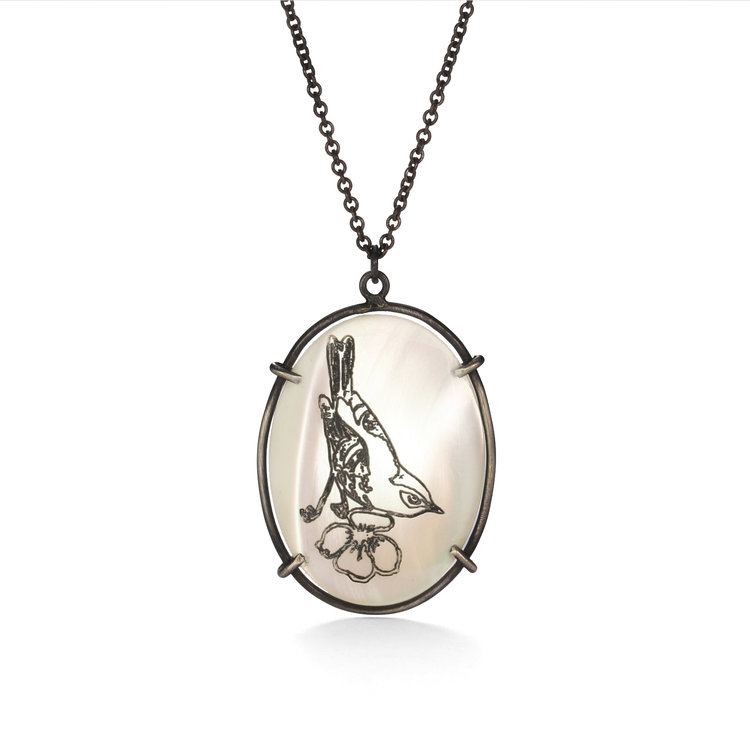
Pictured below is an image of one of Conroy’s works where she has laser-etched hand-drawn images onto faces of mother of pearl.

Figure 2 Conroy, K., Neckpiece. [ONLINE]2

The Beauty of Death

Beauty of Death

Conroy uses imagery of flora and fauna in her jewellery to express her “ideas about the cycle of life and the beauty and sadness in death” (Conroy, n.d.). She creates jewellery pieces that contain the actual dried bodies of dead animals with stones and pierced out motifs of flowers and butterflies. In doing this, Conroy creates ornate arrangements that help to “beautify” and break the taboos and fears surrounding the idea of death (Conroy, n.d.). Conroy uses jewellery that is worn on the “outer layer” as a reflection of her innermost feelings and emotions surrounding the idea of death and the intricate cycles of life (Conroy, n.d.).

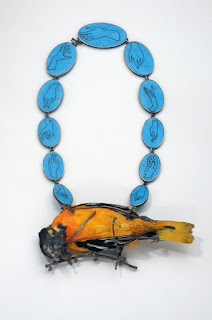
Below is a photograph of a neckpiece that Conroy made using the dried-out body of a bird.

Figure 7 – Conroy, K., Neckpiece.
[ONLINE]7

Motifs, Images and Objects

Motifs, Images and Objects

Conroy uses imagery of plants flowers and animals in her contemporary artworks. She focusses on one single motif and repeats that same image in different shapes and sizes in one single jewellery piece to create a collage neckpiece or ring, sometimes she repeats similar motifs across several of her pieces (Boston Voyager, 2018).

Below are three images of Conroy’s works, in the first image she has repeated a butterfly motif several times in one piece, in the second and third pieces she has repeated the butterfly motif as well as the black flowers made from oxidised sterling silver to create a sculptural collage.


Conroy also uses floral motifs in her wearable pieces where she reflects hand-drawn images of flowers and plants on flat discs of metal, enamel, shell or stone (Boston Voyager, 2018) which she then pierces or etches on to create a sense of negative space.

Below is an image of one of her ‘wearable’ pieces that consist of one single element (Conroy, n.d.). This is an example of how contemporary jewellers can create wearable studio pieces that stem from their contemporary creations.


Figure 3 – Conroy, K., Neckpiece.
 [ONLINE]3


Figure 4 – Conroy, K., Neckpiece. [ONLINE]4

Figure 5 – Conroy, K., Neckpiece. [ONLINE]5


Figure 6 – Conroy, K., Neckpiece. [ONLINE]6


Emotional Connection to Place

Emotional Connection to Place

The concept behind Legg’s work focusses on the emotional connection that people have with a place which is known as “topophilia” (Legg 2012:46). Legg creates jewellery pieces that speak about the emotional connection that she has with her home town and she does this by making jewellery pieces that resemble landscapes that she photographs while taking walks. Legg explains that feelings of strong emotion can be experienced after an external sensory stimulus or through an internal interpretation of a memory that is sparked by an object we encounter (Legg 2012:36). The textures, forms and colours that Legg incorporates in her pieces evoke the same emotions that she experienced in a place (Damasio 1999:58).


 Legg, B (2013). Sketchbook Pages Drawings Page 180 [ONLINE]

Walking as a Research Tool

 Walking as a Research Tool

In Legg’s research paper, The Materiality of Place, she speaks about the importance that walking has on a creative individual and how it aids as a research tool allowing us to better understand the environment and to expand our knowledge thereof. Legg being a designer that relies on the natural environment for inspiration often takes walks to forage for photographs or interesting tangible objects that she uses to create pieces of jewellery (Legg 2012:139). According to Legg, walking “is comprehension of how both urban and natural spaces can be moulded by different eventualities: the different light during the day, the weather, the memories evoked by a certain atmosphere, noise or smell, and the emotional state of mind of the individual.” (Legg 2012:59)

Legg, B (2016). Brooch, [ONLINE]

Beth Legg

Beth Legg: Jewellery Style

Beth Legg creates organic contemporary and studio pieces that are made from a variety of materials including sterling silver, wood, stone, pearls, horn and objects that she finds in the natural environment around her. Legg creates her jewellery pieces to resemble the landscapes and scenery in the area of Northern Scotland where she lives. Legg often takes walks as a form of research in her environment to capture images of the scenery that she uses for design inspiration (Legg, 2012:58), she then creates pieces of jewellery to resonate elements within the captured image and when placed side by side, the jewellery and the captured image create a beautiful juxtaposition. Legg mimics the textures, forms, silhouettes and colours of the sceneries around her (Legg, n.d.) to create jewellery pieces that have a reflection of the emotions that she experiences in her environment (Legg, 2012:194). Many of her pieces appear organic because of their form resembling objects found in nature, such as twigs, pods and leaves. Other objects have an organic hint to them due to the surface texture present resembling objects found in nature (Legg, n.d.).


Figure 1 – Legg, B (2009). River’s Mouth. 
Neckpiece, Oxidised Sterling Silver, 
Garnet, 18ct Yellow Gold [ONLINE]1

Tuesday, 17 September 2019

Chapter 2

Introduction


In this chapter I will examine the styles, techniques and concepts that other jewellery artists use to create contemporary jewellery pieces that reflect similar aspects that I am incorporating in my own body of work. I will focus on jewellery artists that draw inspiration from the natural world to create organic jewellery as well as artists that represent or reflect their inner emotions, memories and experiences in the pieces that they create.


Wednesday, 31 July 2019

Victoria Walker- Metaphor and Movement

Walkers pieces have a precious quality to them, not just because they are made with precious metals but because they have create a sense of sentimentality when the beauty, that is kept hidden inside, is suddenly and surprisingly  revealed to an unsuspecting eye. Walker creates "the idea that sometimes the most precious and treasured elements are hidden beneath the surface. " creating a beautiful metaphor that describes the human soul. 

Victoria walker motifs and Techniques

Walker's kinetic lockets are hand made using the techniques of piercing, domeing, drilling and soldering to create almost lifelike realisticly appearing pieces such as her thistle pendants, where each spike on the surface of the pod is soldered on by hand. Walker also uses various metals to recreate the different colours and hues found in nature, including silver, copper and gold and they are buffed and sanded to have a rough, non shiny finish to resemble the plant of inspiration. As a contrast,  some of her pieces are decorated with small shiny stones or pearls that allow her pieces to be more precious. 
Thistle Pendant Victoria Walker, Sterling Silver Gold

Victoria walker Jewellery Style

Walker's jewellery consists of small locket like  jewellery pieces that open and close with touch or with the movement of the body. Walker creates her jewellery to resemble the opening and closing of flowers and seed pods such as roses, thistles, daisies, sunflowers and the lotus flower.   The petals of the flowers are made out of thin domed pieces of metal that are connected to a base with small jump rings to create tiny hinge like systems that are able to move up and down. These hinge like systems of petals are surrounded by a moving shaft that, when moved down, allow the petals to tilt down to reveal a beautiful metal flower, when the shaft moves up, the petals are then forced up into the shaft to resemble a seed pod or bud. 


Wednesday, 24 July 2019

Silhouette Neckpiece

In the last week I also worked on the Segments of Gooseberry plant silhouettes that was inspired by Kelly Jean Conroy's neckpiece which is made up of outlines and silhouettes of twigs, flowers and butterflies. Conroy uses these images in her work as they form part of her childhood memories. I think in a way,  this is a a form of self reflection, as she states in her bio that an item of jewellery is a " tangible object to be worn on one’s outer layer  " and that deep emotion, sorrow associated with death in Conroy's case,  is something that is present in our inner most layers. She uses jewellery to bring out her inner most emotion in the form of tangeable objects. The images from her childhood have become representations or symbols of her emotions associated with death.
Segments of Silhouettes
In a way, my idea of the work that I am creating is also similar to that of Conroy's not just visually but also conceptually. I use imagery of nature seen around me as symbols to represent the current phase of my life and the emotions/feelings/happenings that occur within this period of time. When I have fully completed this piece I will understand the full meaning behind it. For now, the silhouette images of one Gooseberry plant taken at different angles  represent the different areas of my life. the images are made up of one plant, but at different perspectives, just like my one life that is made up of many aspects. My Btech, my work, my family, my relationship and my social life. All these together shape the way that I see the world and how I think.

Thursday, 20 June 2019

Rene Lalique


Rene Lalique

Rene Lalique was one of the most influential designers of the Art Nouveau period. Lalique was well learned in ceramics, glasswork and metalsmithing and he often combined his skills to create exquisite items of jewellery.

Lalique’s style was unique and unconventional for the 1800’s as he incorporated non precious materials into his works. His style of aesthetics was influenced by Japonism, a style movement in France in the 1800’s that stemmed from realist Japanese art. Lalique’s work consisted of elements and motifs found in nature, of flowers, insects, animals and birds that were combined to create magnificent neckpieces, diadems, hairpins and brooches. He also used pearls, early plastics, glass and horn that was carved to decorate his works.

Lalique’s works became metaphors of the turn-of-the-century ideas and concerns, these ideas included, transformation, changes in society and the gender roles of women. Along with the natural imagery, he often portrayed images of nude women in his works allowing a form of femininity to manifest in his work. His “metaphors for this included butterflies, fish, water and frogs. The rise to fame of women like Sarah Bernhardt and Loie Fuller and the sensual, self-willed image they projected were part of the changing perceptions of the role of women at the time”.


Kelly Jean Conroy


Kelly Jean Conroy

Is an enthusiastic metalsmith and teaches in Massachusetts, America. She makes contemporary and conceptual pieces as well as wearable studio jewellery pieces that she sells online. All of her pieces have some sort of organic influence to them. Many of her pieces are representational to objects found in nature and others are made out of natural objects such as bones, dried flowers and dead animals.
Conroy’s work consists of sketches of birds and flowers that are etched onto metal and shell. she also creates neckpieces that consists of fragments of bone, dead bodies of birds and pierced elements in metal. Conroy sources all of her design elements from her childhood memories, and finds it important that the motifs of nature used in her designs have a personal significance to her.

 I am drawn to her aesthetic style as well as the deeper conceptual meaning behind her work and how she uses the motifs found in nature that are associated with her childhood memories as a form of self reflection. 

Conceptually, Conroy uses these elements to express her “ideas about the cycle of life and the beauty and sadness in death”. She creates jewellery pieces that beautify and break the taboos and fears surrounding the idea of death. Conroy uses her work as a reflection of her inner most feelings and emotions surrounding the idea of death. I want to Use nature nature as a representation or symbol of my personal life and the emotions and ideas associated with the happenings therein.

I feel that my work relates to Conroy’s work to an extent because my jewellery reflects my personal ideas about life and me as a person. I also use elements that represent memories and significant moments in my life. My aesthetics also reflect nature as I create jewellery items that are representational to nature.